










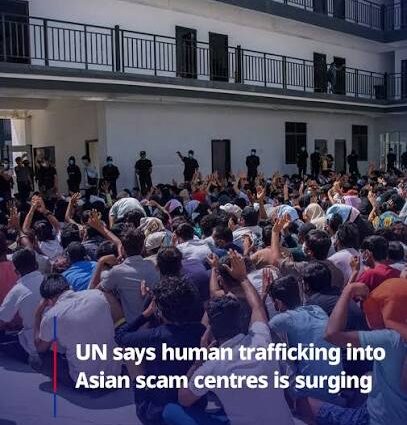
The International Organization for Migration (IOM) has raised alarm over a sharp rise in human trafficking into online scam centres across Southeast Asia, warning that people from more than 80 countries, including Ghana, are being deceived with fake job offers before being forced into cyber-enabled fraud operations.
According to the United Nations migration agency, criminal syndicates operating large-scale scam compounds in countries such as Myanmar, Cambodia and Laos have expanded their recruitment efforts through social media platforms and online job advertisements, targeting individuals seeking better employment opportunities abroad.
The IOM estimates that as many as 300,000 people may currently be working in these scam compounds across the region. While the centres are notorious for carrying out sophisticated online fraud targeting victims often elderly individuals in Europe, North America and other parts of the world. The agency stressed that many of the workers are themselves victims of human trafficking.
The agency said traffickers commonly advertise what appear to be legitimate, high-paying jobs requiring strong English language skills, customer service experience or a university education. Applicants are promised attractive salaries, accommodation and travel arrangements, only to discover upon arrival that they have been trapped.
Victims reportedly have their passports and identity documents confiscated and are subjected to intimidation, physical abuse and psychological coercion. Many are forced to operate investment scams, cryptocurrency fraud, romance scams and other forms of online deception under constant surveillance. Those who fail to meet fraud targets are often threatened with violence or sold to other criminal groups.
The IOM also warned that some victims have reported experiencing sexual abuse, torture and other serious human rights violations while being held inside the heavily guarded compounds.
The inclusion of Ghana among the more than 80 affected countries highlights the growing global reach of these trafficking networks. Young professionals, graduates and job seekers looking for overseas employment remain particularly vulnerable to fraudulent recruitment schemes promoted through social media, messaging applications and online recruitment platforms.
The UN agency is urging governments to strengthen cross-border cooperation to dismantle trafficking networks, improve victim identification and provide protection and rehabilitation for survivors. It also called on the public to exercise caution when responding to overseas job offers that promise unusually high salaries or require immediate travel without proper verification.
Cybersecurity experts have also advised prospective job seekers to verify the legitimacy of recruitment agencies, conduct background checks on employers and avoid sharing personal documents with unknown recruiters online.
The IOM reiterated that combating these criminal enterprises requires coordinated international action involving law enforcement agencies, technology companies and governments to disrupt the trafficking pipeline and protect vulnerable populations from exploitation.
As cyber-enabled crime continues to evolve, authorities warn that preventing human trafficking into scam compounds is now as much a cybersecurity challenge as it is a humanitarian one.
About The Author

